EXTRACTION SHOOTERS AREN'T BATTLE ROYALE'S CHILDREN. THEY'RE THE ARCADE'S GHOST.
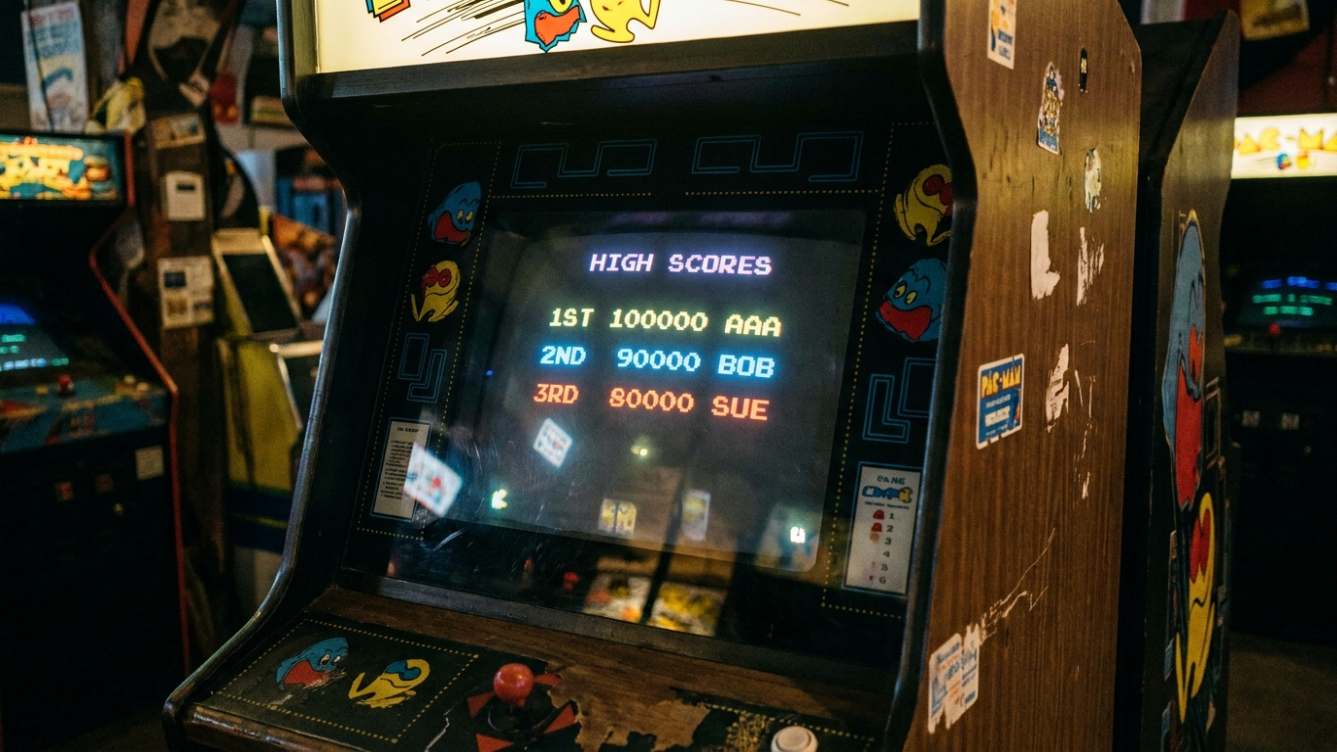
Walter Day spent four months in 1981 driving to arcades across America with a notebook, writing down the highest number on each cabinet's screen. Day, founder of Twin Galaxies, visited more than 100 video game arcades over four months, recording the high scores that he found on each game. There was no prize money. There was a number, your three initials, and the people who would see them. Every arcade cabinet came with its own scoreboard, the original competitive ladder. Getting your initials on that list meant status. It wasn't about money; it was about immortality.
Hold that image. We're coming back to it.
The story everyone tells
The conventional wisdom is tidy. Battle royale exploded with PUBG and Fortnite, the market got crowded, and extraction shooters are what you get when you take battle royale, slow it down, and bolt on a loot economy. The lineage is treated as settled. One outlet literally calls the genre a spin-off of battle royale shooter games, while still having its own identity. Even reference write-ups frame it that way, noting the genre contains elements of the Roguelike and Battle Royale Game.
You can see why people reach for it. Both drop you on a map. Both shrink your options as a round progresses. Both made their names on Twitch. The surface resemblance is real.
But the surface is where the resemblance ends, and the lazy genealogy hides what's actually driving these games.
The turn
Battle royale answers one question: are you the last one standing? It's a tournament. There is exactly one winner per match and everyone else is a loser, full stop. The structure is elimination, and elimination has a binary output.
Extraction shooters don't ask that question at all. Unlike battle royales, there is no single winner. The core tension comes from the risk of losing everything collected during a run, making every encounter a high-stakes decision. You can extract while forty other players also extract. You don't beat them. You beat the run. The thing you're measuring yourself against isn't the lobby, it's your own accumulated stake and your nerve to protect it.
That is not a battle royale instinct. That is an arcade instinct. It's the quarter in the slot, the score climbing, the cold calculation of whether to push for the next board or cash out while you're alive. The genre's own designers understood this from the start. The original Tarkov tagline was, in essence, "Battle simulation in a hazardous environment." Not a battle to be the last. A hazard to survive and walk away from.
What the arcade actually taught
Strip the arcade scoreboard down to its mechanics and you get three things. A run that can end at any second. A score that exists only as long as you keep yourself alive. And the gut-punch when the screen flashes GAME OVER and the number you were nursing evaporates.
Extraction shooters rebuilt all three, just with guns and a stash instead of a points counter. Escape from Tarkov combined traditional FPS mechanics with loot collection but also introduced a core risk-reward loop in which death meant losing all your equipment. Death isn't a respawn timer. Death is the screen going dark with your score wiped. The currency changed from points to gear, but the emotional engine is identical: the longer you survive, the more you have to lose, and the more it hurts to lose it.
This is why the genre is so famously hostile. Since all equipment is the player's property, there is a possibility of permanently losing it, and the extreme stress, tension, and immersion resulting from the risk are typical characteristics of extraction shooters. The arcade did the same thing with no narrative cover at all. James Vollandt sat at a Joust machine for the better part of three days. He carried his Joust game for 67½ hours. The game malfunctioned at around 58 hours, wiping out all of his 210 extra lives. However, he earned back forty of them. He left voluntarily with a record-breaking score of 107,216,700 points. Nobody made him do that. The number made him do that. The fear of losing the number made him do that. That's the same psychology that keeps a Tarkov player crouched in a bush deciding whether the next loot room is worth their kit.
Battle royale doesn't have this. When you die in Fortnite you lose a placement, not a hoard. There's no stash that persists between runs, no slowly compounding stake that turns every match into a referendum on your loss aversion. The whole point of battle royale is that everyone starts equal every game. The whole point of an extraction shooter, like the arcade before it, is that you carry your run forward and you can be made to pay for it.
The reframe
Here's the deeper read the battle-royale framing misses. The arcade scoreboard wasn't really about the game. It was a social ledger. Your initials sat on that cabinet for everyone who walked up after you. Twin Galaxies turned that into a global institution, and the press treated it as real. Twin Galaxies was the only organization back in the 1980s whose game-playing rules, high score statistics, and contest results were recognized and accepted by the Guinness World Records book. High-score charts ran in newspapers and magazines for years. Twin Galaxies' high-score charts appeared in USA Today, Games magazine, and were distributed by the Knight-Ridder news service.
The scoreboard made performance public, and public performance made spectacle. That's the part battle royale gets credit for, but it inherited it. When people say extraction shooters were built on Twitch, they're describing a 1982 phenomenon with a 2017 delivery system. While initially rather obscure, Tarkov would eventually garner a large following, especially via Twitch livestreams. The audience watching a streamer sweat over whether to extract is the same crowd that gathered behind the cabinet to watch someone defend a top score. Same ritual. Same stakes-as-theater. Different decade.
Why this matters now
Because the genre just had its breakout year, and the winners are the ones who understood the arcade lesson, not the battle-royale one.
ARC Raiders launched in October 2025 and did numbers most shooters never see. Its all-time Steam peak is 481,966 concurrent players, recorded on November 16, 2025. Across all platforms, Nexon confirmed a peak of 960,000 concurrent players in January 2026. Tarkov itself, after roughly eight years in beta, finally hit a 1.0 release the same season. Escape from Tarkov had been in a beta state since July 28th, 2017, and made 400 updates over the course of that eight-year journey. Version 1.0 was released on 15 November 2025.
But notice the texture of the success. ARC Raiders shed most of its launch crowd within months, a steep drop off the November peak. That looks like failure if you think you're running a battle royale, where a fat concurrent number is the scoreboard. It looks completely normal if you understand the real model. The arcade never needed a packed room. It needed a few obsessives willing to feed it quarters for sixty-seven hours straight. Extraction shooters live or die on retention by the committed, not raw reach, which is exactly why the genre tolerates being a genre with very strong likes and dislikes and a limited user base. The arcade had that exact shape. Most people walked past the cabinet. A handful never left it.
The honest counterargument
The fair objection: the arcade was about a number, and extraction shooters are about stuff. Loot, gear, a persistent stash, a hideout to upgrade. That's an RPG progression layer the arcade never had, and it pulls the genre toward MMO and survival design as much as anything else. Tarkov's own makers describe it as borrowing elements from massively multiplayer online games. That's true, and it's the strongest case against me.
But progression isn't the engine. It's the fuel. The reason the gear matters is that it can be ripped away in a single bad fight, and that loss is what generates the tension. Take away permanent loss and you have a looter shooter, a Destiny, a treadmill where you only ever climb. Nobody calls those extraction shooters. The defining feature isn't the accumulation. It's the cliff at the edge of every run. Strip the RPG veneer off and what's left is the oldest mechanic in the medium: a score you can lose by dying, and the choice of whether to risk it for more. The arcade just called that score "points."
The arcade never died. It put on body armor, learned to stream, and started calling the high score a stash. Same quarter. Same prayer at the extraction point. Same dark screen waiting if you get greedy.