GOOGLE RATIONING GEMINI TO META ISN'T A BUBBLE POPPING. IT'S WORSE.
Here's the headline everyone reached for: the AI bubble is popping, and Google just proved it by cutting off Meta. It's a clean story. It's also probably wrong, and the reason it's wrong is more alarming than the version people are scared of.
Start with what actually happened. Google told Meta around March 2026 that it could not provide all of the Gemini capacity Meta wanted to purchase, and the shortfall disrupted and delayed some of Meta's internal AI projects. The reporting originated with the Financial Times, which Reuters, Bloomberg, and others then relayed. Google capped Meta's use of its Gemini models in March after Meta sought more capacity than Google could supply, and the restriction pushed the company to tell staff to use AI tokens, the units that measure AI usage, more efficiently. Meta wasn't singled out for being small. It was "particularly impacted because of its exceptionally high demand," while other Google Cloud clients were also affected.
Why "bubble" is the wrong word
A bubble is a glut. Too much product, not enough buyers, warehouses full of stuff nobody wants. That is the 2000 telecom story people keep pattern-matching to, and it is the exact opposite of what the numbers show now.
Alphabet said Google Cloud backlog nearly doubled quarter over quarter to more than $460 billion. Sundar Pichai acknowledged that compute shortages held back what could have been even stronger results, and that unmet demand pushed the division's order backlog to nearly twice the prior quarter. Read that again. The constraint wasn't demand. It was the ability to deliver. In plain terms: demand is not the issue. Deliverable capacity is.
And Google isn't rationing because it's cheap. Google is so compute-constrained that it agreed to pay SpaceX $920 million a month for access to 110,000 Nvidia GPUs, calling it "bridge capacity" to meet surging demand for Gemini Enterprise. This is a company that, per widely reported figures, owns one of the world's largest pools of AI infrastructure and is spending over $180 billion on capex this year, and still cannot serve all of its customers' demand. Nobody rents emergency capacity from a rocket company at those prices when supply is plentiful.
So the "bubble about to pop" framing has a real problem, and it's worth being honest about it rather than pretending the counterargument doesn't exist. You cannot inflate a bubble in something the market is currently rationing. If anything, the near-term picture is a shortage, not a glut.
The actual bad news is the pipeline
Here's where the story turns, and it's the part the bubble-versus-no-bubble shouting match skips. The crunch is not a snapshot. It's a curve, and the curve points the wrong way.
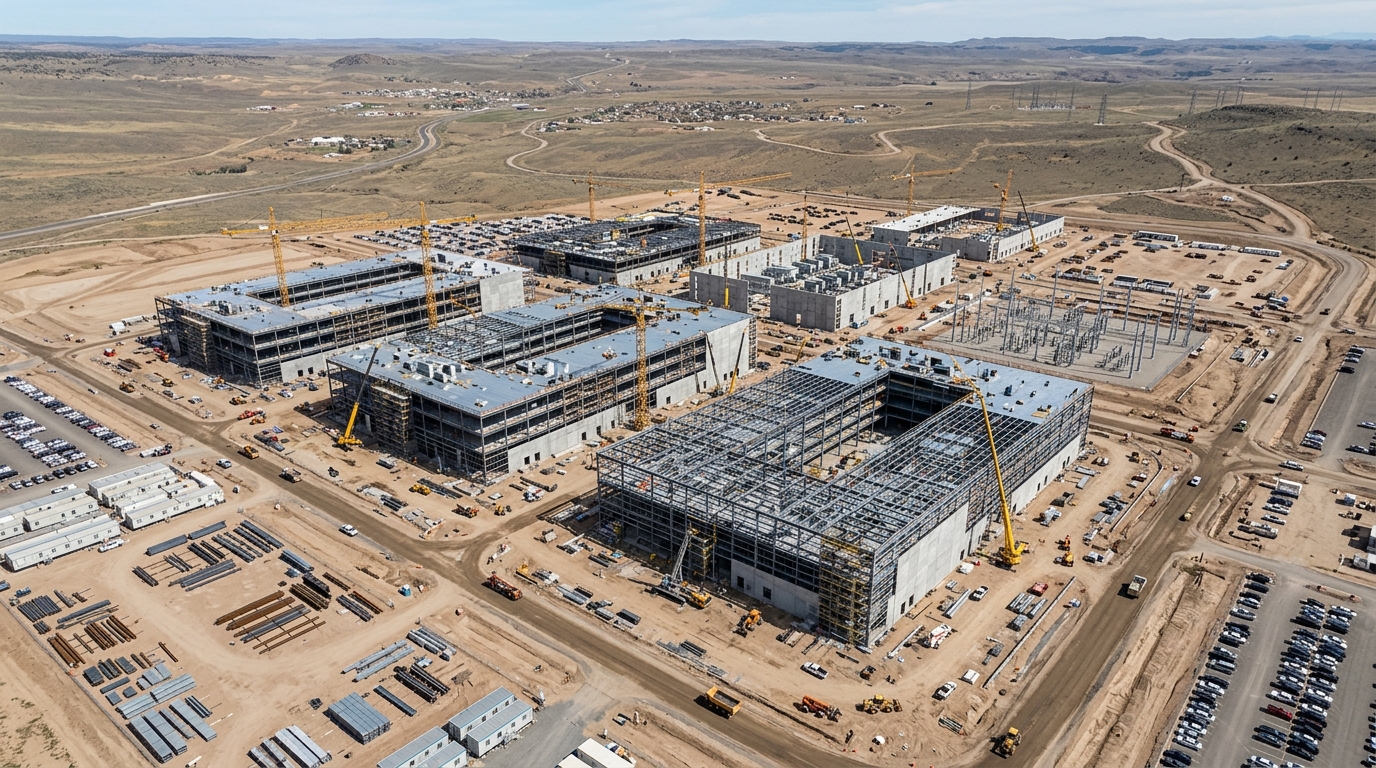
SynMax estimates more than 60% of data center projects scheduled for next year have yet to begin construction. Look at the 2027 cohort specifically. Among data centers slated to open in 2027, only about 6.3 gigawatts worth of computing infrastructure are actually under construction, compared to 21.5 announced gigawatts. That's under a third of what's been promised, with the clock already running. Beyond that, visibility collapses: an additional 37 gigawatts of planned capacity exists on paper, but only 4.5 gigawatts has broken ground, and the gap between what's been announced and what's actually being built exceeds 50 gigawatts.
Goldman's version is milder in tone but says the same thing. Only about 50 to 60% of data center capacity scheduled for the next one to two years is expected to come online on time amid delays and cancellations. The reason isn't a lack of money. Executives told the Financial Times the delays came from "chronic shortages of labor, power and equipment" along with permitting. Even mundane parts are bottlenecks. The delays trace to electrical components made abroad; batteries, transformers, and circuit breakers are less than 10 percent of a data center's cost, but it's impossible to build without them.
That's the falsifiable claim worth defending: the Google-Meta episode isn't the top of a bubble, it's an early symptom of a supply gap that widens through 2027. If capacity scheduled for 2027 were mostly under construction today, this thesis would be wrong. It isn't. Roughly a third is.
What it means for the companies burning billions
Every hyperscaler's roadmap assumes the concrete gets poured on time. Meta lifted its full-year 2026 capex outlook to $125 billion to $145 billion, citing higher component pricing and additional data center costs tied to future capacity. That spending is supposed to buy independence from suppliers like Google. But the timing is the trap. It gives Meta room to keep building, but it does not erase near-term dependence. More owned data centers later do not solve a model-capacity shortage today.
So the ledger reads like this. Demand is real and paid for years in advance. Money is not the bottleneck. The bottleneck is grid power, transformers, and the multi-year physics of pouring concrete and wiring substations, none of which respond to a bigger checkbook on any useful timeline. The typical data center takes 18 to 24 months to build once permits are secured.
The bears calling this a bubble are measuring the wrong quantity. But that doesn't make the optimists right either, because the optimists are pricing in capacity that, by the industry's own construction data, may not exist when the roadmaps need it. Google rationing Meta isn't the sound of a bubble bursting. It's the sound of demand hitting a wall that gets taller for at least another two years.