PRAGMATA WAS WORTH THE WAIT, AND THE HACKING GRID IS WHY
Six years is a long time to defend a delay. Pragmata was announced in 2020, aimed for 2022, slipped to 2023, then vanished into what felt like development limbo. Pragmata was originally planned for release in 2022, but a series of delays, including one in 2023 that saw it seemingly shelved indefinitely, ultimately pushed it back by four years. When a game disappears like that, the safe bet is that something went wrong. The safe bet was wrong.
Here's the claim I'll defend, and it's a falsifiable one: Pragmata's central mechanic, the real-time hacking puzzle layered on top of live combat, is not a gimmick bolted onto a normal shooter. It changes the fundamental loop of how you play a third-person shooter, and that single idea justifies the wait. If the hacking were optional, skippable, or cosmetic, this argument falls apart. It isn't, and it doesn't.
What the mechanic actually does
Strip away the lunar setting and the story, and you're left with a structural decision that no major third-person shooter had committed to before. Pragmata features two protagonists who must work together to progress. Hugh Williams is a human who can use various types of firearms to defeat foes and his suit's built-in thrusters to move around the lunar station. Diana is a Pragmata, a unique android made of Lunafilament. She can hack enemies to open their armor and reveal their weak spots.
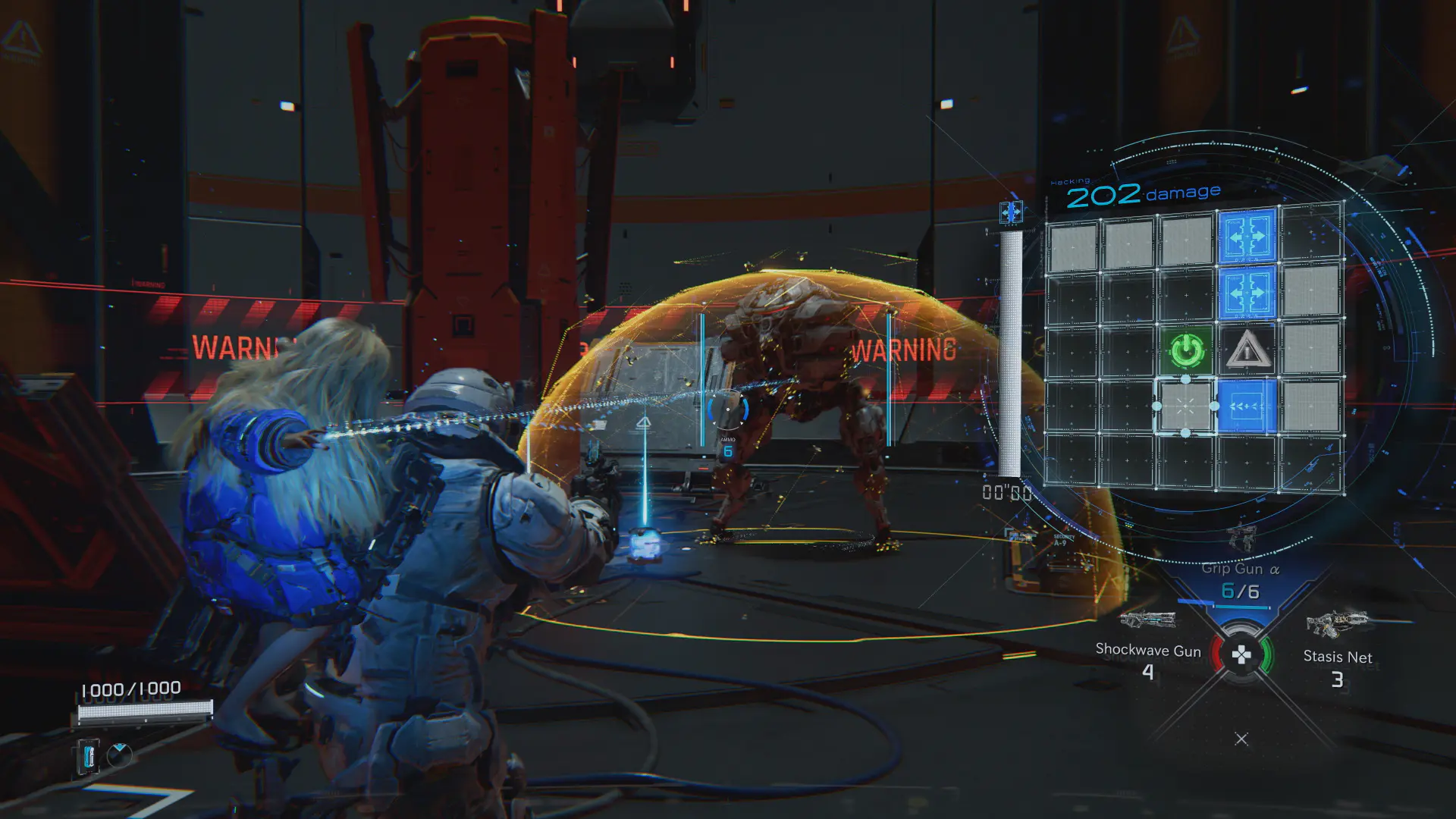
The key word there is "open." Hugh's guns don't just do less damage to unhacked enemies. Since Hugh's earth-produced weapons don't pierce the shells of the moon-based robots, he needs Diana's help to hack the enemies to open up their weak spots. How that plays out in combat is simple but ingenious. While you shoot as Hugh just as you would in any third-person shooter, you need to solve a hacking puzzle in real time to make the robots vulnerable.
This is the part that earns the thesis. You aren't alternating between a shooting phase and a puzzle phase. You're doing both at once. Diana auto-traces a hex grid. You input the next tile direction with the face buttons of your controller (or designated keys on PC). Hugh remains under your full action control — aim, shoot, jetpack, dodge. If Hugh takes damage, Diana's progress freezes for ~0.6 s. Take too many hits and the grid times out. The puzzle and the firefight share one failure state, which means they aren't two systems sitting next to each other. They're one system wearing two faces.
Compare that to how shooters normally handle "depth." They add cover, weapon wheels, ability cooldowns, crafting. All of it sits inside the same attention budget: aim, shoot, reposition. Pragmata splits your attention across two channels that can't be collapsed into one. Reviewers describe exactly that strain. You're essentially controlling both Hugh and Diana at the same time, and the multi-tasking gameplay works phenomenally well. It's the perfect level of simple and intense. Your eyes dart from side to side, making sure you're positioned perfectly, all while your hands race to complete the hacking puzzle.
Why it took a new IP to do it
It's worth asking why Capcom, a studio with deep shooter pedigree, built this from scratch rather than grafting it onto something existing. The honest answer is that the mechanic didn't arrive fully formed. Oyama: It actually didn't start out as a puzzle. We went through a lot of trial and error, testing various ideas to see how we could incorporate hacking into gameplay. After exploring various options, we found that the current puzzle system offered the most intuitive controls and the kind of depth that keeps players engaged over time.
That's where the six years went, and it's the strongest defense of the delay. A team chasing this kind of dual-attention combat had to solve a problem most studios never take on: making two simultaneous skill demands feel intense without feeling like busywork. According to the developers, that was the hard part. The game's lead developers say combatting repetitiveness was a major challenge in making this innovative mechanic. The intent was explicitly to dodge the genre's default. According to producer Edvin Edsö, the tactical hacking was the developer's way of avoiding making another standard shooter and adding an element of strategy to combat engagement.
And critically, the system doesn't stay static. The reason it sustains a full campaign is that it keeps escalating. It helps that Pragmata keeps introducing new elements to Diana's hacking. Ultimate abilities, special nodes that confuse, burn, or even turn enemies against their own, and brutal finishers are all added throughout the 12-hour story. That keeps increasing the complexity, ensuring you're not coasting your way through later encounters.
The strongest counterargument
Now the honest part. The case against my thesis isn't that the mechanic is bad. It's that "splitting your attention" could just be friction dressed up as innovation. A puzzle that pauses combat to make you do homework is annoying, not novel. Plenty of games have "hacking minigames," and most are universally skipped or hated for exactly this reason.
The reason Pragmata survives that critique is balance, and it's the one thing the design absolutely had to get right. Neither element of the combat overwhelms the other, and both feel great without getting old. If the puzzle dominated, you'd be playing a Snake clone with a gun glued on. If the shooting dominated, the hacking would be a tax. The developers describe the target directly. There's a careful and considered balance happening with Pragmata's hack and shoot gameplay, which puts a keen focus on maintaining concentration.
That's a tightrope, and there's a fair worry it doesn't hold for everyone. Anyone who finds the multitasking exhausting rather than exhilarating is going to bounce hard, and that's a real limitation, not a footnote. The thesis here isn't that everyone will love it. It's that the idea is genuinely new and genuinely structural, and that's a higher bar than most "innovative" shooters clear.
What the early verdict suggests
Two signals are hard to wave away. The commercial one: worldwide sales of PRAGMATA, the company's all-new IP released on April 17, 2026, have surpassed one million units. For a brand-new property with no fan base, that's a fast start. The reception one is even more telling for a game built on a single risky idea. On Steam it sits at Overwhelmingly Positive (14,487) - 97% of the 14,487 user reviews for this game are positive.
A divisive gimmick doesn't post a 97% rating. A mechanic that genuinely reframes the genre, and lands, does. The grid is the argument, and six years on, the grid holds up. After having finished the game, I can safely say that Pragmata is amazing and an easy recommendation.